

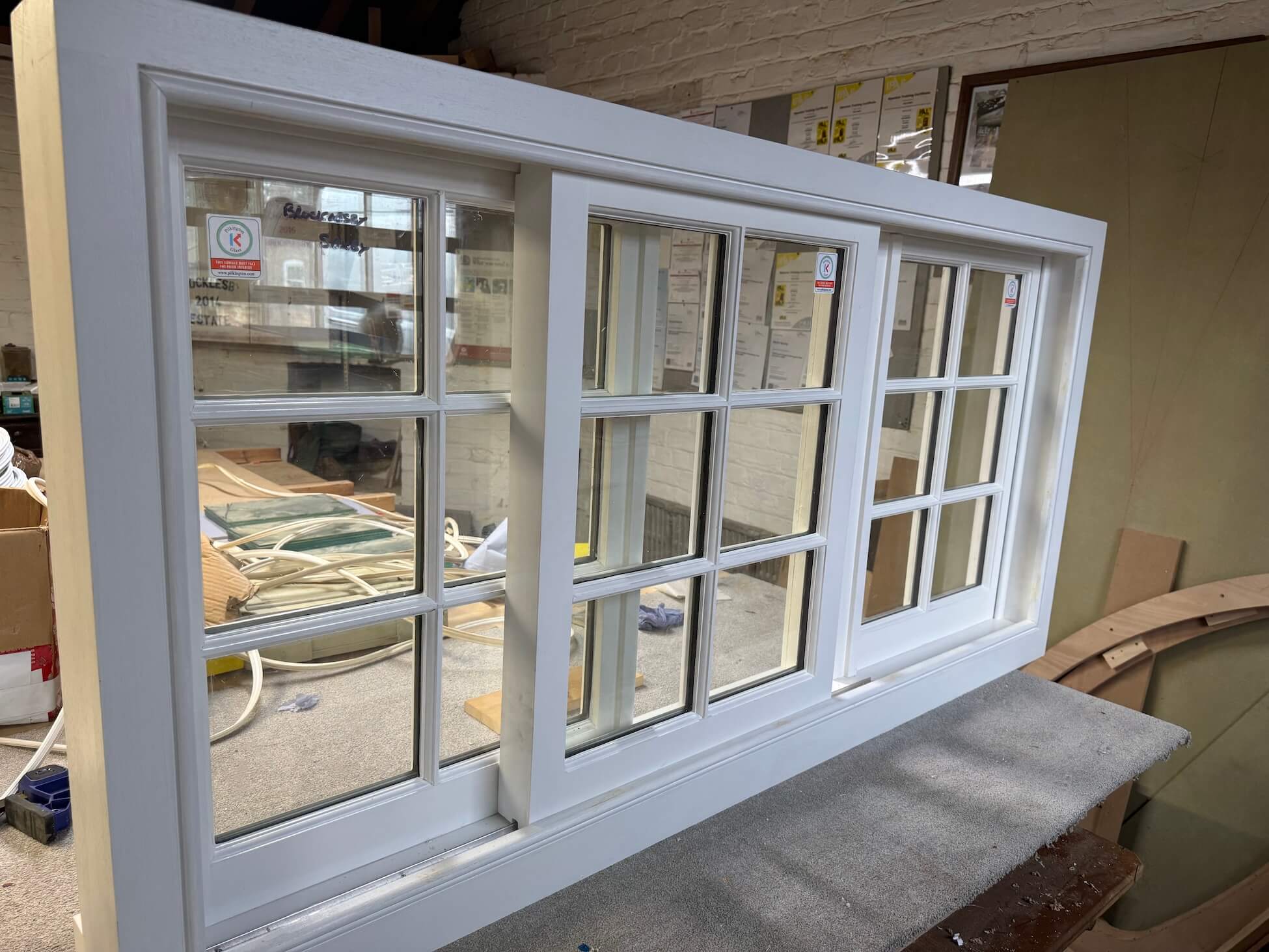
When it comes to timber windows, doors, or bespoke joinery for your home, the type of wood you choose matters far more than you might think. Get it right, and you’ll have beautiful, durable joinery that stands the test of time. Get it wrong, and you could face ongoing maintenance headaches, premature deterioration, or even complete replacement within a few years.
At Pelham Joinery, we’ve been working with timber for over a century. We’ve seen trends come and go, materials evolve, and technologies advance. Through it all, one thing remains constant: the importance of selecting the right wood for each specific application. Here’s what you need to know.
Understanding your options
When planning a timber joinery project, you’ll typically be choosing between three main categories: softwoods, hardwoods, and engineered timber. Each has its place, and understanding their characteristics will help you make an informed decision.
Softwoods – the budget-conscious choice
Softwoods like pine, spruce, and fir have long been popular for joinery work, and for good reason. They’re readily available, relatively affordable, and easy to work with. For painted finishes or projects where budget is a primary concern, softwoods can be an excellent choice.
However, there are some differences compared to other types of wood.
- They’re more susceptible to rot and decay
- They weather faster than hardwood,
- Moisture absorption can lead to swelling, warping, and splitting over time.
These issues are particularly problematic in exposed areas like external window sills, which bear the brunt of standing water and harsh weather.
This is why you’ll often see softwood windows paired with hardwood sills. The hardwood sill takes the weathering and water exposure, whilst the softwood frame provides a cost-effective solution for the less vulnerable areas. It’s a sensible compromise that extends the lifespan of the joinery whilst keeping costs manageable.
The lifespan of softwood comes down to not only its natural attributes, but also the quality of its ongoing treatment, paint quality and maintenance. As with all wood, when looked after, its life will be extended..
Best for: Internal joinery, painted windows and doors, projects with budget constraints, secondary buildings
Be aware: Regular maintenance required, limited durability in exposed conditions, prone to moisture-related movement
Hardwoods – timeless beauty and natural durability
For properties where character, longevity, and natural beauty are paramount, hardwoods remain unmatched. At Pelham Joinery, we predominantly work with oak and sapele, both of which offer exceptional qualities for heritage and conservation projects.
Oak is the classic choice for British joinery. It’s incredibly durable, naturally resistant to decay, and develops a beautiful patina over time. Its distinctive grain pattern and warm tones make it ideal for period properties, listed buildings, and any project where authenticity matters. Oak has been the wood of choice for centuries precisely because it performs so well in our climate.
Sapele, an African hardwood, offers similar durability to mahogany but with better dimensional stability. Its rich reddish-brown colour and interlocking grain make it particularly attractive. It’s naturally resistant to moisture and requires less frequent treatment than many other timbers. For those seeking a slightly more exotic appearance without compromising on performance, sapele is an excellent choice.
Teak deserves a special mention, particularly for external applications like garden furniture and outdoor structures. Long prized for its exceptional durability and natural oils that repel water, teak can withstand decades of exposure to the elements. However, its high cost and sustainability concerns have made it less common in general joinery work.
Best for: Heritage properties, listed buildings, conservation areas, high-quality new builds, natural or stained finishes
Be aware: Higher initial cost, slower growing species (sustainability considerations), can still require maintenance depending on exposure
Engineered/modified timber – the high-performance alternative
In recent years, engineered timber has emerged as a game-changing option, with Accoya leading the field. If you haven’t heard of Accoya, you’re not alone, but this remarkable material deserves serious consideration for any timber joinery project.
Accoya starts life as a sustainably sourced softwood, typically radiata pine from managed forests. It then undergoes a process called acetylation, which modifies the wood at a molecular level. This isn’t a surface treatment or preservative coating. Instead, the process fundamentally changes the wood’s cell structure, making it extraordinarily resistant to rot, decay, and moisture absorption.
The results are impressive.
- Accoya boasts dimensional stability that surpasses even the finest tropical hardwoods.
- It swells and shrinks up to 75% less than traditional timber, meaning windows and doors open smoothly year-round without sticking or jamming.
- Its Class 1 durability rating is the highest possible, and it comes with an industry-leading 50-year warranty for above-ground applications – longer than teak and oak
From a sustainability perspective, Accoya offers the best of both worlds. The radiata pine used to produce it reaches maturity in just 25-30 years, compared to 50-100 years for many commercial hardwoods. Yet Accoya has a service life of 50-70 years, providing a much better turnover of resources without harming slow-growing forest ecosystems.
The thermal performance is another standout feature. Accoya provides superior insulation compared to standard softwoods and hardwoods, outperforming softwoods by up to 8% and hardwoods by as much as 30%. This translates to real energy savings over the life of your windows or doors, keeping your home warmer in winter and cooler in summer.
When you compare Accoya to non-timber alternatives like uPVC and aluminium, the advantages become even clearer. Whilst uPVC windows typically last 20-30 years with warranties of just 10 years, Accoya offers that 50-year guarantee. Unlike plastic, which can look, well, plastic, Accoya retains the natural beauty and warmth of real wood. It can be painted or stained in any colour, and finishes last longer because the wood doesn’t swell and shrink beneath the coating.
Aluminium may be strong, but it’s a poor insulator compared to timber. Even with thermal breaks, metal frames simply can’t match wood’s natural insulating properties. Accoya gives you the strength and longevity whilst maintaining excellent thermal efficiency.
The limitations of Accoya
Although Accoya has many advantages, there are some limitations you need to be aware of.
The acetylation process that gives Accoya its remarkable stability also changes how the wood behaves. Whilst it becomes harder and more dimensionally stable, it also becomes slightly more brittle compared to traditional softwoods or hardwoods. In practical terms, this means Accoya may snap under force where a traditional hardwood might bend.
This characteristic doesn’t significantly limit Accoya’s use in joinery applications – the stability and durability benefits far outweigh this property for windows, doors, and most bespoke joinery work. However, it does mean that skilled craftsmanship becomes even more important during manufacture and installation.
When working with Accoya, we take particular care to use sharp tools and avoid running cutters against the grain to prevent tear-out or splintering. Pilot drilling is essential for all screws and fixings. Whilst the wood can dent with impact and thinner sections may be vulnerable to splitting if subjected to sudden force (such as a door catching in strong wind), proper design and expert craftsmanship mitigate these concerns.
For applications where high impact resistance is paramount, traditional hardwoods may be the better choice. For the vast majority of joinery work, however, Accoya’s exceptional stability and longevity make it an outstanding option.
One important consideration with Accoya that often catches people by surprise: you must use stainless steel fixings, hinges, and hardware. Standard steel fixings will corrode and stain the timber. Whilst this adds slightly to the hardware costs, it’s a small price to pay for the longevity and performance benefits
Accoya provides. Think of it as an investment in ensuring your windows or doors look pristine for decades rather than years.
Best for: High-end projects, exposed locations, homeowners seeking minimal maintenance, eco-conscious builds, modern and heritage properties alike
Be aware: Higher upfront cost than softwood or standard hardwoods, requires stainless steel fixings and ironmongery to prevent corrosion, limited aesthetic variety compared to natural hardwoods’ grain patterns
Making the right choice
So which wood should you choose? The answer depends on several factors:
Budget: If cost is your primary concern and you’re happy to maintain and eventually replace your joinery, softwood with a hardwood sill offers good value. For those who can stretch the budget, both hardwoods and Accoya provide better long-term value despite higher initial costs.
Property type: Heritage and listed buildings often call for traditional hardwoods like oak that match the original character. Modern builds can benefit from Accoya’s cutting-edge performance. Either material can work beautifully in the right context.
Exposure: For sheltered locations, softwoods may suffice. For harsh, exposed conditions, consider Accoya. For a middle ground, traditional hardwoods perform admirably.
Maintenance appetite: If you enjoy maintaining your home and don’t mind repainting every few years, softwood or even hardwood can work well. If you’d rather fit it and forget it, Accoya’s minimal maintenance requirements are compelling.
Environmental priorities: All timber is more sustainable than plastic or metal, but Accoya and other fast-growing species offer the quickest carbon capture and renewal. Responsible hardwood sourcing remains important if choosing traditional species.
Whole life costs: Don’t just look at the initial price tag. A softwood window might cost less, but if it needs replacing every 15 – 20 years compared to something like Accoya that has a lifespan of 50+ years. The more expensive, but longer-lasting, option may work out cheaper in the long run. Our experience
Here at Pelham Joinery, we work with all three categories regularly. For much of our heritage and conservation work, traditional hardwoods like oak remain the authentic choice. They’ve been crafted in our workshop for over a century, and we know them intimately.
However, we’re increasingly specifying Accoya for projects where performance and longevity are paramount. The warranties speak for themselves, and our clients appreciate knowing their investment will endure for generations. For exposed locations, coastal properties, or simply for homeowners who want the very best
performance timber can offer, Accoya has earned its place as our premium recommendation.
The beauty of bespoke joinery is that we can tailor every project to your specific needs and circumstances. Whether you choose softwood, hardwood, or engineered timber, what matters most is that the selection is right for your property, your budget, and your expectations.
Getting it right
Choosing the right timber is just the beginning. Proper design, expert craftsmanship, and appropriate finishing all play crucial roles in ensuring your joinery performs as it should. At Pelham Joinery, we bring over 130 years of experience to every project, from matching historic mouldings to creating contemporary designs that will stand the test of time.
If you’re planning a timber joinery project and would like to discuss which wood would be best for your needs, we’d be delighted to help. Sometimes, a conversation about your property, your priorities, and your vision can illuminate the right choice more clearly than any article can.
After all, we’ve been crafting timber since 1895. We’ve learned a thing or two about wood along the way.